since The Path was released.
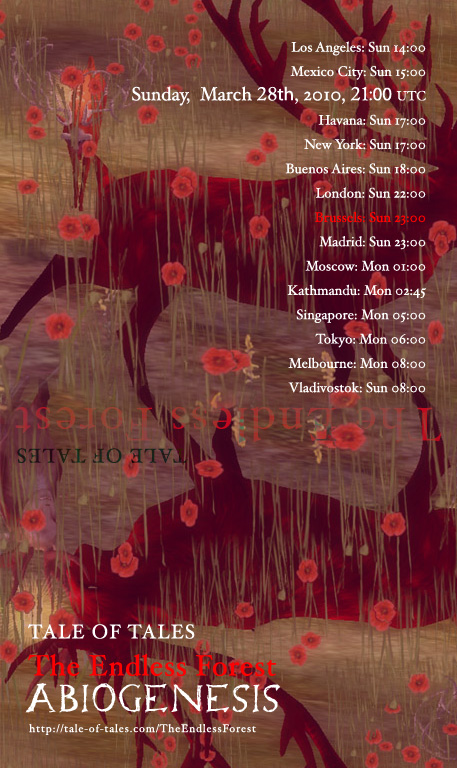
On 18 March 2009, we launched The Path from a room in the hotel where we first met exactly 10 years before. Get ready for celebrating the first anniversary of our six little girls and their very own big bad wolves! Expect an elaborate and revealing post-mortem/making-of, a special limited USB edition package, a nice discount on the regular download, an updated translations patch (now also on Steam!), an interview with a source of inspiration, news about the soundtrack, and of course an Endless Forest bathed in darkness and mist.

And we are not there. :)
Instead, we are at home, working on a new project. A project that doesn’t have a name yet. You can follow what we’re doing on Tumblr where we post some of the reference material that we’re collecting to inspire and inform the design.


We can’t say much about this project yet. Because we don’t know what it will become yet. We have a basic idea but that can still change. It has something to do with flowers, and with locks, and with diagrams of the universe, and with sex. It’s very different from any game we’ve made so far. There’s no story at its basis. There’s no characters. And it might even feel like an actual game -though we’re definitely applying the notgames dogma to this one.
We’ve also done something unusual with the design method. Auriea and I have split up. The new project consists of two very different parts. Auriea is designing one and I am designing the other. And then we’ll bring the two together.
The current phase is a prototyping phase that will run on and off until some time next year. This phase is supported by the Flanders Audiovisual Fund.
To all our friends at GDC: enjoy the event! :)
Now on the App Store: The Graveyard for iPhone and iPod touch. Only 1.99 US Dollars. A free Lite version will be available as soon as Apple approves it (release has been stalled a bit because they disapproved of your use of the word “Trial” and the reference to the full version in the description of the “Lite” one).

From the press release:
The Graveyard offers a player the opportunity to imagine themselves in a certain situation. It’s not a game in the sense that there is a way to win or lose or a puzzle to solve, or even a story to uncover. But the interaction does immerse you in a virtual world filled with narrative, an equally powerful feature of the medium of videogames. The iPhone version of The Graveyard is the same as the PC version. Only a few elements have been removed or simplified to allow it to run on the iPhone hardware. But the fact that you hold the game in your hand and touch it with your finger, adds to the sensation of fragility and preciousness.
(more…)
Main Entry: welt·schmerz
Pronunciation: \ˈvelt-ˌshmerts\
Function: noun
Usage: often capitalized
Etymology: German, from Welt world + Schmerz pain
Date: 1864
1 : mental depression or apathy caused by comparison of the actual state of the world with an ideal state
2 : a mood of sentimental sadness
Weltschmerz (from the German, meaning world-pain or world-weariness) is a term coined by the German author Jean Paul and denotes the kind of feeling experienced by someone who understands that physical reality can never satisfy the demands of the mind.
The modern meaning of Weltschmerz in the German language is the psychological pain caused by sadness that can occur when realizing that someone’s own weaknesses are caused by the inappropriateness and cruelty of the world and (physical and social) circumstances. Weltschmerz in this meaning can cause depression, resignation and escapism,
the prevailing mood of melancholy and pessimism associated with the poets of the Romantic era that arose from their refusal or inability to adjust to those realities of the world that they saw as destructive of their right to subjectivity and personal freedom—a phenomenon thought to typify Romanticism
Weltschmerz was characterized by a nihilistic loathing for the world and a view that was skeptically blasé.
Main Entry: bla·sé
Pronunciation: \blä-ˈzā\
Variant(s): also bla·se
Function: adjective
Etymology: French
Date: 1819
1 : apathetic to pleasure or excitement as a result of excessive indulgence or enjoyment : world-weary
2 : sophisticated, worldly-wise
3 : unconcerned
synonyms see sophisticated

Körperlos, als reine Perspektive schwebt man als Spieler durch die Tempelanlage. Fast wie bei einem Kreuzweg besucht man Station um Station, vordergründig um Kerzen auszulöschen, in Wahrheit aber, um sich der Atmosphäre hinzugeben und um Details der Szenerie wahrzunehmen. Aus herumliegenden Schleiern, den Séparées, dem Henker und vielen weiteren, nicht nur ernst gemeinten Elementen (Zündholzschachtel mit Telefonnummer Salomes!) baut sich im Kopf des Spielers die fatal endende Geschichte auf. Man muss sich auf die Atmosphäre einlassen, sich in die Szenerie vertiefen, denn das Andeutungsgeflecht erweist sich als nicht dicht genug gewebt, um eindeutige Schlüsse ziehen zu können.
Alois Pumhösel, Der Standard
We’re embarking on a new project today. Two new projects, actually. It’s an experiment. Instead of working on them in sequence, we’ll work on one one month, then on the other the next. The idea is to increase the development time of both. Because we’ve experienced that not working on something and just allowing it to grow over time, makes it a big difference.
Over the next 18 months, we will be prototyping two new largish games. None of this work will be published. And even after the prototyping phase, it will take some time before we bring the projects to production and release. So it’s going to be quiet around here for quite a while.
That doesn’t mean we will disappear completely. While working on the prototypes, we will be doing a few small projects too, and we may release some things related to the old projects.
For various reasons, up til now Vanitas was not downloadable by users of the 1st generation iPod Touch. At first, because we didn’t get a chance to test it on this older hardware. Then after we did, when we tried to update to allow for it, Apple had suddenly, inexplicably, changed their policy on how to specify hardware restrictions. This left many developers scratching their heads how to allow or restrict what hardware their apps can run on. Apple had to fix our AppStore listing by hand to get things straight. Needless to say we are happy to now announce that Vanitas will run on any version of the iThings! iPod or iPhone, regardless of age.
So, 1st gen iPod Touch users, you can now play too!


Also, a few helpful tips for things that may not have been so obvious.
TIPS:
- Use multitouch to levitate up to 3 objects at once.
- Find the authors of the quotes by clicking the url at the top of the info screen.
- It is easier to get a gold star at lower levels so, try your luck with the reset button on the 3rd info screen.
enjoy!
The world is flat. The sun turns around it. The clouds too. Sometimes the clouds float behind the sun, sometimes in front of it. The sun is afraid of the moon. The moon brings darkness.
In the wake of The Art History of Games symposium, Tracy V. Wilson’s question as to whether art games are (still) games made me realize that Frank Lantz’s observation that Doom is like rock and roll may hold even more water than I originally assumed.
Maybe we can think of rock and roll as a kind of “hyper” version of traditional folk music that was made possible through technology (electronically amplified instruments and vinyl records). Much like videogames could be seen as a “hyper” version of traditional games enabled by the technology of computers (both as creative tool and distribution platform). Like videogames, rock and roll added a certain vitality and emotional depth to an ancient tradition that totally absorbed a new generation. *
This analogy gets really interesting for me when we start thinking of more extreme or experimental forms of rock music. In the beginning, rock and roll, like videogames, was relatively straightforward and all about fun. But then some people started experimenting and things like The Doors and Velvet Underground happened, followed soon by Sex Pistols, Crass and Dead Kennedys. **
One could argue that the music of Sonic Youth, Psychic TV or Einstürzende Neubauten is as much removed from the “fun” of rock and roll as the games by Jason Rohrer, Daniel Benmergui and yours truly are from the “fun” of videogames. Interestingly, it seems that it is exactly in the deviation that this type of rock (or videogames) starts claiming artistic value. Not only by virtue of not being fun, but also by introducing “alien” elements to the form like noise, unusual structures or narrative content previously deemed unsuitable.

The hairline may be only one of many things that Jason Rohrer shares more with Johny Rotten than with Jackson Pollock.
So rather than thinking of people who experiment with videogames as new Jackon Pollocks or Kiki Smiths, maybe we should think of them as new Nick Caves or Siouxsie Siouxs. They are taking a new technological incarnation of an old analog form and are introducing elements to it that seem to contradict the form’s original merits. And by doing so, they get closer to what is commonly perceived of as artistic.
Next to the more rock-oriented deviations, we may soon be seeing the videogames equivalents of Philip Glass and Michael Nyman and perhaps even Stockhausen or Górecki, as some developers may reject not only the “hyper” version of the form (rock and roll/videogame) but also its non-electronic predecessor (folk music/game).
All this time, of course, rock and roll, as videogames, continues to exist. Once in a while it is influenced by the more artistic experiments. But often it is not. And the two co-exist, appealing often to different audiences, but equally often not without significant overlaps. Sometimes we like playing Mario. Sometimes we immerse ourselves in The Void. Much like sometimes we dance to Abba while other times we need a dose of Cocteau Twins.
* Oddly, there’s a similarity between the two on a social level too. Both traditional games and folk music are often group activities that are mostly about interacting with other humans and having a fun time together. Rock and roll and videogames add a much more explicit notion of authorship to the form and introduce a more severe separation between author and audience, up to the point where enjoying the music or the game could become a solitary activity, thanks to reproduction and distribution technologies.
** Punk is an interesting case because it started as anti-rock and roll but was quickly reintroduced into the mainstream via bands like The Ramones and The Clash who made it fun again.
On Thursday, February 18th, we’ll be presenting our working at the ARCO art fair in Madrid. We were invited by Domenico Quaranta to talk about our work at a symposium entitled “EXPANDING THE FIELD. Or, 8 good reasons to talk about new media (in an art fair)”. Other guests are Hans Bernhard and lizvlx of UBERMORGEN.COM, Marius Watz, Trevor Paglen, Oron Catts and Paul D. Miller (aka DJ Spooky).
Something is happening in the field of art. Postmodernism seems to have been replaced, but nobody is really able to say by what. Art critics such as Nicolas Bourriaud and Carolyn Christov-Bakargiev explained this change looking backwards to Modernism, but Modernism itself is many things, and it’s still not clear if this new modern, or Altermodern, is rooted in a new utopianism, as argued by Christov-Bakargiev, or in creolisation, globalisation and travelling, as suggested by Bourriaud.
What is clear to both is that new technologies, in the broader meaning of the term, are having a central role in this change. Starting from here, and appropriating Ippolito and Blais’ idea that the change will come from artists operating “at the edge of art” – Expanding the Field will involve artists and researchers that address, with different approaches, various new technologies – from the Internet to videogames and biotechnology – and issues and practices of the digital culture, from media hacking to data mining and surveillance.
Should be fun! ;)
And we’ll have an entire day to spend at the Prado!
ARCO Art Fair, Forum Auditorium 2, Hall 6.
February 18, 2010, from 12.30 to 2.30 p.m. and from 4 to 8 p.m.
(we’re scheduled at 6)