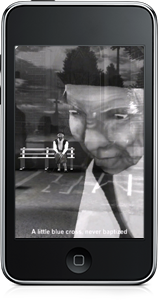
We have posted the text and slides of our presentation at the Art History of Games symposium last Saturday in Atlanta.
Videogames are stuck. Despite of the ongoing technical evolution and the continuous calls for a new medium, videogames have stopped evolving. They have found their comfort zone. Videogames are happy. Happy being exactly what they are. Fun activities that nurture our inner child.
While our inner grown-up is starving!
We need a new medium that can help us cope with the complexity of our post-historic universe. The interactive, non-linear and generative capacity of computer technology offers such a medium. There is no need however to limit what we create with this technology to the format of games. The possibilities are endless.
There’s a lot of work to do.
Videogames have taken computer technology hostage. It is time to liberate the medium and start feeding our starving hearts and minds. We need to stop making games and look further, go farther, step into a new world. Create interactive entertainment for all instead of squeezing people into oppressive sets of rules and goals. We have the technology. We have the desire. So let’s get to work!
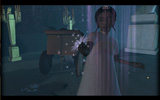
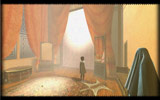
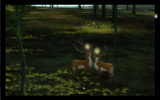
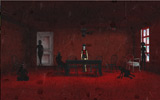
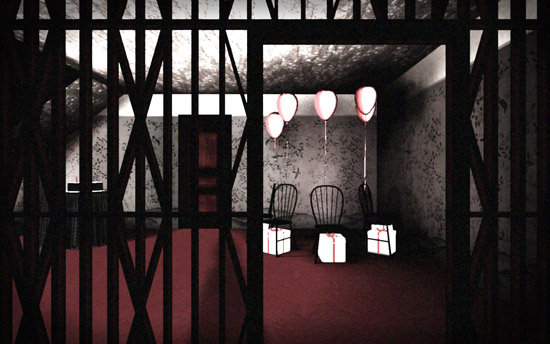
Vanitas is a memento mori in your iPhone. A meditative app without rules or rewards with Zoë Keating on solo cello.
“Despite using contemporary technology, we are artistically inspired mostly by pre-modern art,” admit creators Auriea Harvey and Michael Samyn. “In the 16th and 17th centuries, many Dutch and Flemish painters created still lives with symbols that referred to man’s mortality. They were named after a famous quotation from the Bible by Ecclesiastes: “Vanitas vanitatum omnia vanitas”. Or “Vanity of vanities, all is vanity”, implying that everything we do in life is without meaning. Creating a “Vanitas” painting for the iPhone felt like the appropriate response to the commission by Ian Bogost and John Sharp.”
Vanitas was commissioned for the Art History of Games symposium and exhibition by the Savannah College of Art and Design and the Georgia Institute of Technology Program in Digital Media. The symposium opens tonight.
Our first iPhone app Vanitas will be launched on February 4 at the opening of the Art History of Games symposium for which it was commissioned. Vanitas will be exhibited in a special installation (including live ladybugs!), next to games commissioned from Jason Rohrer and Nathalie Pozzi & Eric Zimmerman, at the Kai Lin Art gallery in Atlanta, Georgia, USA, from Thursday, February 4 until Tuesday, March 2. The opening reception will take place Friday, February 5 from 8:00 pm until 10:00 pm. More information here.
There’s still some tickets for the symposium and exhibition.Register here!
And don’t forget to check the App Store as of 4 February!
Tale of Tales ha logrado recrear la figura de la Salomé de Wilde a un nivel de complejidad asombroso, creando a partir de ella una obra con sentido y valor propio. Un trabajo minucioso que da pie a una obra que no será bien recibida por todos los públicos, pero ya se sabe que los grandes artistas siempre vienen acompañados de polémica.
And no, there’s no score. ;)
Posted by Michaël Samyn on January 19, 2010 | 6 comments | Filed Under: Fatale, Press
Frictional Games is one of the most ambitious and at the same time under-appreciated independent developers. They are one of very few forward looking companies in the independent scene and don’t nearly get enough credit for it (this year’s IGF proved no exception with its jury ignorantly rejecting Frictional’s new project “Amnesia“).
Anyway, Frictional’s Thomas Grip has written a very clear analysis of how the “focus on narrative and gameplay is holding back interactive media’s potential”. The little essay echoes our own thoughts on the subject but Mr Grip suggests a certain terminology that is very helpful (if not entirely intuitive), opposing meaning to narrative and interaction to gameplay. With us, he is “quite convinced (…) that there is a vast new world to explore if the interaction is in focus, instead of gameplay and narrative”.
While gameplay at the core of game making, it comes with a lot of baggage and makes certain meanings harder to realize in the medium. The most striking issue is the entire failure mechanism that is used in just about any game. You try a certain task, you fail and then have to repeat it. As described in other posts, this can be especially damaging in horror games, where repeating scenes seriously lessens the experience. This mechanism also imposes limits on the player’s rate of progress and effectively tells the player: “Either you complete this or you will not proceed!”. Other baggage include the notion that gameplay must be fun and the need to constantly pose challenges. What I mean with the last point is that players assume that a game will always keep them occupied with some kind of obstacle to overcome. This leads to very little interactive content that is added for its intrinsic sake alone. Instead a game’s interactive content almost always have some connection to the goals of the gameplay.
Ian Bogost has commissioned us to make a game to be revealed at the Art History of Games symposium in Atlanta. That game will be Vanitas, reported on earlier. Next to us, two other games have been commissioned. One by Jason Rohrer and one by Eric Zimmerman and Nathalie Pozzi. We applaud the initiative to commission artsists to create new pieces. Wish it would happen more often.
And if that wasn’t enough, the 3 day symposium will have presentations by all sorts of interesting speakers: Ian Bogost himself of course, but also Jay David Bolter, Brenda Brathwaite, Jesper Juul, Christoph Kluetsch, Frank Lantz, Henry Lowood, Michael Nitsche, Christiane Paul, Celia Pearce, John Romero, John Sharp and of course the commissioned artists (expect some provocative statements!).
Hope to see you there!
Register now for The Art History of Games, a symposium and exhibition jointly organized by SCAD-Atlanta and the Georgia Institute of Technology
February 4-6, 2010
Rich Auditorium at the High Museum of Art
1280 Peachtree St N.E., Atlanta GA 30308
The Art History of Games is a three-day public symposium in which members of the fields of game studies, art history and related areas of cultural studies gather to investigate games as an art form.
Speakers include:
* John Romero, designer of Doom and co-founder of Gazillion Entertainment
* Christiane Paul, New School professor and Whitney Museum adjunct curator
* Jesper Juul, author of A Casual Revolution
* Brenda Brathwaite, creator of Vanguard Award-winning Train
* Frank Lantz, designer of Drop7 and Parking Wars
* And more…
Attendees are also invited to attend the premiere of three commissioned art games by Jason Rohrer, Tale of Tales, and Nathalie Pozzi and Eric Zimmerman, at Kai Lin Art (800 Peachtree St. N.E.).
Early registration ends Thusday, January 14: $15 for SCAD and Georgia Tech students, $25 for academics and students from other institutions, and $40 for the general public.
Today we’ve submitted our first app for iPhone/iPod touch to the Apple app store for approval! Excitement!!
It is called Vanitas.
Vanitas has been commissioned for The Art History of Games, a public symposium which is taking place February 4th-6th, in Atlanta, Georgia, USA, at the High Museum of Art. Where we will be attending and speaking among good company. We are one of 3 developers selected to make something on occasion of the event. The other two being Jason Rohrer and Eric Zimmerman. All 3 projects will be at a special exhibition at the Kai Lin Gallery during the conference and for a month afterwards. We’re planning something special for the gallery … ;)
Vanitas is not a game. Hopefully the approval process won’t get complicated. It should be available in time for the exhibition opening, then you can find what its all about!
The start of a new decade feels like an appropriate time to get ambitious. Out with the old, in with the new! Not that there’s going to be any extreme changes around here. My resolutions mostly concern a change in attitude, in philosophy. But, with any luck, they will take us further. And in the right direction.
While these resolutions have been bubbling up for a while, two things were direct triggers: Auriea’s realisation that her favourite games of the decade are all over 5 years old and our recent visit to the Belgian incarnation of the historical Game On exhibition where it became very clear how much more fun the old arcade games are than the new pseudo-narrative shiny next gen titles upon which I had based a lot of my hopes.
Independence!
We don’t want to make obscure art. This is a big part of the reason why we choose to work with digital media. We don’t even want to make art per se. We just want to share beautiful moments and elegant thoughts with people who are open to them. And perhaps, in our most audacious daydreams, we’d hope to make a small contribution to a more harmonious world.
Accessibility is one of the reasons why we don’t shy away from commerce. Commerce is an efficient way to distribute things in a capitalist system. And thanks to the abundance of the digital, we can sell our work very cheaply. But commerce also has a way of confusing an artist, of holding you back. Commerce forces you to think about seduction -even when it’s not appropriate- and to favour projects with commercial potential over others that might be more relevant artistically. We like our work to be accessible. But we want that to be an artistic choice and not an economic requirement.
We’re not very good at commerce anyway. We don’t have clever business minds. And our work is just a bit too far away from the ordinary to appeal to people who do. But above all, thinking about commerce -however exciting it may sometimes be- always ends in bogging us down, to slowing us down, to depressing us.
I want us to become less dependent. Less dependent on money, less dependent on success, less dependent on quantity. And focus exclusively on quality. This includes improving the accessibility of our work! While commercial pressure may motivate one to lower the threshold of their productions, it only does so towards a specific target audience, effectively locking everyone else out. It would be possible to optimize our work to be very accessible for hardcore gamers. But at the expensive of other people we might also want to communicate with. We want our work to be more widely accessible. We don’t want to depend on any specific niche.
None of this leads to any radical decisions. This is just a resolution that can guide us when making future decisions. As of now, I want to focus on self-sufficiency. And favour non-profit or break-even operations over commercial ones. Or even figure out ways to make losing money bearable. It’s ok if that means working on smaller projects. As long as they are “big on the inside”.
Games over
This year, I’m going to care less about games. And as a result, I will probably enjoy them more.
I give up.
I give up on my hopes for videogames to become a valid cultural medium.
I’ve been fighting very hard. I’ve been putting my money where my mouth is. For several years already. Almost a decade.
But the games industry is merrily traveling in the opposite direction. Videogames are not changing anymore. They seem to have lost that capacity. Sure, the technology still evolves, so everything gets more shiny. But this is not leading to any sort of evolution, let alone the required revolution. The desire is simply not there.
Because videogames are happy just as they are. The videogame culture is extremely pleased with itself. A few years ago, people were still complaining about “sequelitis”. No everybody merrily plays Hip Shootgame #13 and Cool Jumpgame #26, with no objections. On the contrary! Everybody gets very solemn and deep when yet another war simulator hits the shelves. Only to forget it within the first week of release.
Gamers, publishers, journalists are all very happy! Who am I to spoil their fun? If they feel comfortable in a juvenile ghetto that is irrelevant to culture, good for them. I’m out of here.
Maybe this is another incarnation of my desire for independence: I want to be independent from the games industry. And from the games format.
Games are fun. Let them be fun. And let’s do something else, when we want to be serious. Let’s focus on interactive entertainment that is not games (let’s call them “notgames” for now :) ). With a technology that is so versatile and powerful, why should we limit our productions and enjoyment to the single format of games, a format that has been around for centuries and doesn’t even need computers to exist?
I realize that it has always been our mission at Tale of Tales to explore the potential of the interactive medium. But so far, this has happened in some form of conflict with videogames, based on our misguided belief that videogames had potential to grow, to grow into a medium (which, believe it our not, still seemed possible only 5 years ago). Simply letting go of the connection, will make our job a lot easier as it will help us explore with far less constraints. Leaving behind the idea that we’re making a game, opens up a world of creative possibilities!
Notgames
But more than that, I want to stimulate research and development of notgames. Instead of continuously having senseless arguments with game fans, developers and theorists, I want to gather together the brightest ideas concerning non-game interactive entertainment. Without the noise and the distractions. Maybe we’ll start a blog about the subject, with news, essays, opinion pieces, debates. A place where ideas can be explored and shared and discussed. I would also like to commission designers and artists to make new non-game interactive projects. Maybe there can be a competition like those ubiquitous game making competitions, but about making interactive entertainment that is not games -far more exciting and certainly a much larger area to explore. And finally, I’m looking into the possibility of starting a sort of label -like a record label- to publish and distribute notgames.
If you would like to contribute to any of this, please post a comment or send email.
When we hit the 50,000 registered players mark, we didn’t realize how close we were to running out of names for our deer. If that’s not a nice testament to how two people who know next to nothing about mathematics can still make complicated computer software, I don’t know what is. ;)
Behold the new generation of deer names in version 3.31 of The Endless Forest.
Good for another 50,000 players!
When we designed The Endless Forest, we wanted to avoid language as much as possible. First of all because language puts a barrier between people, and we wanted The Endless Forest to be harmonious. Secondly, we wanted to avoid violence and competitive behaviour as much as possible. Language is often used in multiplayer games for insults and other out of character behaviour. So we decided to have no chat in our game. And we came up with the idea of using abstract symbols instead of text-based names to identify players. These symbols are easy enough to memorize to recognize your friends and still disconnected from the humans behind the avatar sufficiently, to encourage spontaneous playing together with total strangers.
The symbols are made up of a limited range of elements that are combined to form pictograms. Players can choose a pictogram for their deer when they register for the game. when they login, this pictogram appears above the head of the deer avatar (in a reference to the legend of Saint Hubert, who was converted to Christianity after encountering a deer with a crucifix between its antlers).
Since the amount of elements from which pictograms are composed, is limited, however, there are only a limited amount of unique pictograms. And we ran into that limit last month. So we closed registration for a while and created a new pictogram “alphabet”.
This solution was part of the original design of the game. To create generations of pictograms, which would contribute to the story of The Endless Forest. First generation deer will be older (wiser, more experienced, etc) than second generation deer. And so on.
You can name your deer here.
Please note that you’ll need the very latest version of The Endless Forest to see the new pictograms (version 3.31). You can download it here.
The shortlist for the Independent Games Festival has been revealed. The good news is that our entry FATALE was not selected and so we don’t have to go through Homeland Security Fun ParkSan Francisco in Spring. The bad news is that the selection is rather… boring? Only a few noteworthy games were selected. I guess this confirms Derek Yu’s observation that 2009 was a slow year for indie games. Good thing my New Year’s Resolution includes a goodbye to games (*). Otherwise, I think I’d be sort of… upset?
Decided to take the difficult step of listing what I feel were my most worthwhile gaming experiences of the past 10 years. (Inspired by the top 12 list compiled by Gamasutra)
All the games on this list had to fit several criteria: a) I had to have played it all the way through. Indeed, most of these I’ve played multiple times. b) They had to have changed my life in some way. Either in the “ah, I wish I could make that” inspirational kind of way. Or by virtue of having added some meaning to my existence and stuck with me even though I played them long ago… (games can do that.) So…
10. Neverwinter Nights (played 2002-2004)
The only RPG in 10 years that I’ve played all the way through, multiple times, obsessively. (And all the official expansion packs, plus many adventures that were created in the player community.) I got very involved with this game. I became fascinated by how it was made, the character design, how the authoring tools worked, how its multiplayer worked. I guess this was the first game-with-an-editor I really looked to for insight of how big games are put together. The minimal GUI, that right click radial menu, sweet design decisions. NWN and A Tale in The Desert were big for me in imagining how navigation could work for The Endless Forest.
9. Shadow of Memories (played 2001)
A “choose your own adventure” type story with the character going backwards and forwards through time to figure out his own murder. One of the more complex plots of any game I played the last 10 years, actually. One of the only games I’ve ever played multiple times just to find out what all the alternate endings were. I wish there were more games like THIS… now, today, with contemporary graphics and less cut scenes. sigh.
8. Kessen II (played 2002)
At the time I was totally blown away by the aesthetics of this one. Kind of a cheesy plot (even if it is _based on Romance of the Three Kingdoms) but still, very engaging. I remember that I loved the over the top character design and the magic effects when spellcasting. I wanted to think up a game that needed such elaborate stuff as that! And while it is an RTS, it wasn’t so very much of an RTS to turn me off. I enjoyed winning the game and then starting it over playing from the “bad guy” point of view. But yeah, for me it was all about the particle effects!
7. there is no number 7. I WOULD put The Path here… but that would just be weird ;) … Gotta admit though, I love it best and the game changed my life more than any other…
6. Silent Hill 3 (played 2003)
SH3 was one of those games I anticipated for months, scouring game sites for screenshots and shaky conference videos. Every time I found something new, it showed me how beautiful game graphics could be. Amazing character design and even the plot worked… maybe a bit too much. The main character of Heather was truly unique. A teenage girl. The soundtrack was absolutely perfect blend of mall pop and creepy Yamaoka standards. I credit this game with, what is for me, the scariest and eeriest put-down-the-controller-and-back-away moment in gaming. (I’m not gonna spoil it for you… have a “Making of” video instead.)
5. Black & White (played 2001-2002)
Peter Molyneux is an idiot for having listened to critics of this game. It is the most amazing game he has ever made. He had such an awe-inspiring team of programers and the freedom to execute some unique ideas! For all the flaws, it’s a work of genius. I lost entire days! Lost in being a god over those little worlds. The zooming in to see the tiny details and then backing out and being the master of all I surveyed! Training my animal to mimic me. Miracles! No other game swept me away like that. And you bet it influenced us a wee bit when making the ABIOGENESIS feature in The Endless Forest. Biggest disappointment of the decade was when Black & White 2 turned out to be completely different and more of an RTS than a god game.
3. Animal Crossing (played 2004-ongoing)
The whole family played this game for a solid year on Gamecube. It was the must-have reason I bought a Nintendo DS. We got it for the Wii and it is STILL the only game we play with any regularity. Relaxing, bonding, creative. I admire it for actually trying to trigger nostalgia, and succeeding! Memories of my AC town on a sunny fall afternoon with the cicadas chirping and I, at the waterfall, fishing for Coelacanth… If we ever make a simulation game, this will be the reason why.
2. Silent Hill 2 (played 2001)
I can credit this game as the reason why when Michael suggested we should try our hand at making video games, I said YES absolutely. Before playing SH2 I had no idea a game could get to me like that. SH2 didn’t seem to make any concessions; confusing, ruthless, imperfect. I wanted to make something like that. YES.
This, is my #1 favorite cutscene in any game, ever.
1. Ico (played 2002)
We were working on the scenario of 8 and making the first demos. Michael found a news item on some game site about Ico. We were astounded at the description, in that it had a lot in common with our designs for 8. We kept the game on our radar and bought it the day it came out. Like no other game played this decade, with Ico I was moved, I was inspired to tears of joy and sorrow. If you ask me, THIS is Fumito Ueda’s masterpiece. When seeing a character’s idle motion carries with it so much meaning. When I long to go back to the sundrenched grassy knoll just to chase the birds. To hold Yorda’s hand, listen to the waterfall and stare at the view. When I cannot wait to meet the “boss” because I know it is the coolest moment in the game. It has to be my favorite game of the decade.
Now look at this list.
Isn’t it odd that the games I loved most were all in the years 2001-2004. And nothing after 2004.
I guess the “Next Gen” has been a total disaster for the gamer in me. There has not been one game that’s really done it for me since 2004! A few have tried to worm their way under my skin. I could list the short stint I did in Guild Wars or the myriad DS games I played (like the Phoenix Wright series or Osu! Tatakae! Ouendan!) that I thoroughly enjoyed. I regret that I couldn’t play Portal… I bet I would have liked that one. I’ve played some great indie games lately too. And on PS3 there’s been smaller games like flOw and Flower, and my Game of The Year is Noby Noby Boy. That one, yes, I found it refreshing!
Perhaps I’ve gotten harder to please as I get more analytical about what goes on in the industry or maybe it’s, as Michael believes, that creativity has lost ground to technology and pandering for cash. I have gotten older, my interests have changed, I am busier maybe. Loads of reasons why I have not found the joy in many games lately…. still its too bad. I miss the good old days.
Six of these years we’ve been making games, hardly a surprise that I had more fun with games before it became my “job” so to speak. I guess because I could take things more for granted, and everything seemed so much more like magic. I’m of course hoping that in this shiny new decade I will find games that have that certain something, and I can game, once again, like its 2002.
Our invitation to judge in the Independent Games Festival was withdrawn when we said we were submitting an entry ourselves. As it turns out, that was probably a smart move. Because when I had a look at each of the 301 entries in the festival, I couldn’t resist the urge to compare them with our own. And, frankly, FATALE beats them all, in every category. :) This is why I have only selected 4 games for each prize in the festival. The fifth game -and clear winner- of each category is our own FATALE. I’m sorry, I just can’t be objective about this. :)
I have based my selection on the information available on the IGF website, the game developers’ own websites, videos and screenshots. I have played demos and games when they were publicly available. But I must admit that some of my choices were based on very little data. So I reserve a margin of error. I could have missed a really great project. And I could have included a rather lousy one. Apologies ahead of time.
Apart from simply choosing the most interesting projects in each category, I have tried to limit the amount of overlap between the different categories. Which wasn’t always easy because interesting entries tend to be good in several categories simultaneously. such as our own wonderful FATALE, for instance
Despite of the high quality of some, I have rejected games created by DigiPen students because I don’t consider them serious contenders. The IGF has a separate competition for student work. I hope they use this category in the future.
I make no secret about the fact that the thing I like most about the games industry is its girlfriend its potential. There are many videogames that are fine games as such, even on the independent scene. If you want to play a game, there’s an enormous amount on offer. But I know this computer of ours can do a lot more. I even believe that it can bring us a new medium, a medium as relevant and important to our times as cinema was to the previous century and printing to the centuries before. But the developers who strive for such greatness are few and far between. Even on the independent scene, where one would expect them in larger numbers than in the so-called mainstream industry.
If I had to make an absolute judgment, I’d probably send each and every game in the IGF back to the drawing board (including our own amazing FATALE). Luckily I can suffice with a relative selection. So I have chosen games that give me hope for the future of the medium. Games that are ambitious, that try to explore interesting terrain and/or allow us to do so while playing.
Windosill brings back fond memories of computer-based entertainment’s early days, when an interactive piece could just be called a “CD Rom” instead of getting labeled “GAME”. I think we could do much worse than reconnect with that time and pick up what was so rudely interrupted: playful interaction without the need to compete or achieve. Fig. 8 is equally whimsical but more challenging. But its challenge reminds of the real-world challenge of trying to ride a bicycle as a child, so it feels a lot more natural than in most games. It’s also a wonderful illustration of how a videogame can simply be a journey. Amnesia: The dark descent is probably the most ambitious game in the festival. Its scope and aesthetic rival -and exceed- many of the productions in the commercial industry, even. This is the kind of game I would like to see more of on the independent scene: uncompromising exploration of the narrative potential of high tech. Trauma re-invents the idea of an interactive movie in a spectacular and exciting way. It combines an intuitive and beautiful control system with an intimate engaging story (expressed by means of superb voice acting).
I was pleasantly surprised by the care that independent developers are starting to put in the aesthetic presentation of their games. The “faux amateur” style seems to no longer be a badge of honour. Good riddance, too. Because there’s a lot of work to be done.
I was also glad to see that, next to some excellent examples of traditional 3D aesthetics, several developers are starting to explore real-time 3D aesthetics in an experimental way. In A New Zero all shapes are reduced to their bare minimum covered with a seductive colour palette, that can almost make you forget you’re playing a relatively banal war game. Doppelscope adds to its simplification of shapes a new kind of sensory experience that affects the entire environment and doesn’t shy away from a bit of glossy spectacle here and there. Many entries in this year’s festival feature silhouettes as their main graphical element. But aesthetically, Limbo, is the superior game of the entire lot. Saturated Dreamers surprised me. The characters that seem to carry the story are naive art at best, and actual typography has been carefully avoided, but the playing reveals an interesting generative canvas of unlikely combinations of shapes and colours. I like the aesthetic connection it suggests between computer-based geometry and walllpaper and textile patterns.
I was not very impressed with the sound in most entries this year. Sound still seems to be very much an afterthought for most independent developers. Which is a real shame, considering how powerful its effect can be on the player.
There’s a lot of music games out there. Many use the music to structure simple gameplay (last year’s audio category winner Audio Surf seems to have influenced a lot of designers) and others allow you to create some kind of music-like soundscape through interaction. Microsia stands out by successfully combining amusing interaction with actual composition. Broken Brothers didn’t fall into the tired trap of adding soft piano music to a war game but opted for a menacing oppressive soundtrack through minimal and almost humoristic means on top of melancholic music that actually helps you concentrate on your strategies of destruction rather than making you feel oh so bad about killing the enemy. Demonica‘s musical wall of sound is probably the most atmospheric entry in the festival. Doppelscope confronts electronic sounds with human interaction in analogy with how it expresses its theme of nature preservation through a very synthetic stylized look. Makes playing with computers feel hip again, without the need to resort to retro aesthetics.
I don’t think videogames need to be games as such. But for this category, I selected videogames that I find well designed as games in the strict sense of the word. The fact that two of them are dressed up as space conquest games only illustrates how irrelevant story and meaning are when it comes to pure game design. Both Galcon and Constellation are wonderfully simple-yet-complex systems that are fascinating to interact with. Dangerous High School Girls in Trouble! does have a story. Quite an extensive one, even. But it feels so much like a board game that I couldn’t resist putting it in this category. Windosill is probably the only game I selected for this category that is undisputedly at home on the computer. And in an irresistibly charming way at that. Games this playful are too rare.
I’m considering this category as the place for art works. Not necessarily “art games” but simply artistic pieces that use game concepts or technology. Lose/Lose reminds me a lot of the some of the net.art of the 90s we used to be involved in, especially the work of Jodi. I may not be the world’s greatest fan of modern art, but I like seeing it become part of independent game development. If only because game distribution would offer media artists an alternative venue for showing their work. A venue that is more appropriate for the digital medium, in my opinion. The other games are more interesting as experiences, rather than simple conceptual statements. There’s something very melancholic about playing with people who have been playing before you but are not at the moment (hell is other people). Wait may be ugly but it has a very inspiring game mechanic (which is rare in indie games). And A Slow Year simply appeals to me because of its references to traditional painting and the link that it makes between nature and machines.
All videogames are small miracles. Contrary to popular belief, computer hardware is still incredibly slow, unwieldy and inaccessible. But of all software that one can make with a computer, real-time 3D games must be the most complicated and technically impressive. There’s a tendency on the independent developers scene to look down on 3D games. But I think that’s just a self defense reflex that should not impair our judgment.
With the exception of Amnesia: The dark descent, none of the games I selected in this category are games that I would play myself. But I want to pay tribute to the effort that the developers are doing to, independently, create such technically ambitious projects. Hopefully their work encourages other indie developers and artists not to shy away in their comfortable flat platformer and shooter zones.
2009 Was another triumphant year for the Wii and DS. Nintendo has successfully introduced the general public to playing games on computer hardware. But this is far from a triumph for the medium of videogames.
Nintendo didn’t do much. But they were smart about it. Rather than trying to start a revolution with a brand new medium, they had a good look at the way people play today and made digital versions of those activities. They basically made it possible for people to play the kinds of games they were already enjoying, on their television sets.
Some may celebrate this as the breakthrough of videogames into the mainstream. I don’t. I hope this is just a temporary setback in the evolution of the medium. I’m not a big fan of huge corporations, but I do share, to some extent, the dreams that Sony and Microsoft have about the interactive medium. With them, I see videogames as the great new art form of the new century. Videogames as the cinema, television and pop music of the young millennium.
It’s not about getting as many people as possible to play games (they were already playing games, have been doing that since the dawn of time, there’s nothing new here). It’s about giving our times, our cultures a medium that we can find ourselves in, that we can express ourselves in. A medium that can help us understand our world, and that can help define it. Just as literature and cinema have done in the past.
Nintendo does not share this dream. They never have. Mario and Zelda and Pokemon are nothing like Scarlett O’Hara, Jean-Luc Picard or Romeo and Juliet. Nintendo makes games. It’s what they do. And they’re successful at it.
But the dream of Sony and Microsoft reaches a lot further. They want to be part of your life style, part of your culture, embedded in your society. They want the experiences you have on their systems to be meaningful and dramatic. They’re not selling fun. They’re selling mystery and wonder, spectacle and discovery, experiences you have never had before.
And they failed. Massively. So much so that they are hurrying to try and pick some crumbs left behind by Nintendo by quickly introducing some motion sensing hardware to their systems. The irony of the cats following the mouse would be amusing if it weren’t so sad.
The failure of the nerds
Nintendo got one thing right. It’s an extremely obvious thing. But Sony and Microsoft continuously fail at recognizing it. Nintendo realized that the mainstream audience does not consist of nerds -in fact, one could argue that that is the very definition of a mainstream audience. As soon as they did, they were instantly successful.
There’s a lesson to be learned here. The “hardcore industry” has always insisted that games were great just as they were, that it was just a matter of time before the masses would start playing them. They were basically expecting that everyone would become a nerd. Obviously this did not happen. And it never will. If only because language doesn’t allow it. Nerd and mainstream are polar opposites.
The games themselves were not the problem. Any expert will point out that there is not a lot of difference between Tic Tac Toe and Gears of War, or between Super Mario and Devil May Cry. But Nintendo -finally- realized that people don’t play games for the pretty characters or the great stories but for the systems of interaction that they allow us to engage in. And those systems are far better served by simple graphics and sounds than by elaborate theatrical displays.
The games that Sony and Microsoft have been promoting were basically the digital equivalent of chess sets with pieces made to look like characters from Star Wars or Lord of the Rings. Only 1337 H4x0rz would actually believe they were attacking the Death Star while playing a match with such a set. Most people simply prefer to play a straight-up game with traditional pieces.
Games and… something else?
So now we’re at a crossroads. Do we give up the dream of a new medium for a new century and follow Nintendo’s example of simply giving people what they expect? Or do we strive for greatness and realize the potential of this marvellous new technology?
Nintendo has made one thing clear: people want to play games. But only if the games are simple and straightforward. They don’t want pretty pictures on their games or sweeping stories. They just want to have fun. However, the same people who are having fun with the Wii, also enjoy a visit to the cinema. They also love reading books. Their eyes fill with tears when listening to their favourite pop tune. And they’re hooked on several television shows. These people are not insensitive to narrative, emotion or meaning. They just don’t want to mix those experiences with playing games.
So the solution seems clear. If we want to realize the dream, if we want to give the new century the medium it deserves, the medium it needs, the medium it is sorely lacking, we need to stop wasting this technology on games!
It’s a difficult step to take. Because we love our games. We love battling our giant demons and riding our fire breathing dragons. We love planning our global wars and feeling the rush of victory against improbable odds. But let’s face it: we’re nerds. And only nerds like this kind of stuff. In the clear light of day, a sober eye quickly recognizes these videogames as the superb kitsch they are. Such videogames appeal exclusively to an educated elite and/or marginal ghetto.
This doesn’t mean that it is impossible to create interactive entertainment for people outside of the core niche. People still love their stories, and they still need fiction to help them deal with reality. And people also love to interact with their machines. That has ceased to be a geek exclusive a long time ago -if it ever was one. We just need to work a bit harder.
Instead of simply skinning ancient game routines with high tech spectacle, we need to sit down and have a good look at our medium-to-be and understand what is so uniquely interesting about it. Instead of trying to use new technology to do old tricks, we need to figure out what it is exactly that we find so fascinating about playing on a computer. And translate this to new audiences. This is not an easy thing to do, and it will take a lot of trial and error. But the rewards are great and the accomplishment will completely overshadow any of Nintendo’s current successes.
Down or up?
Will Sony and Microsoft realize this any time soon? I doubt it. The fight seems to have moved from the living room to the play room, from the media store to the toy store. And they will battle it out right there, on the brightly coloured carpet, in between the Barbie dolls and plastic machine guns, while the rest of the world is aching for a new medium, a medium that can deal with the complexities of today’s society, a fiction that can help us cope with our confusing realities.
I feel we have a responsibility here. A duty, even. We have a choice. We can continue to make geek kitsch for the niche audience of hardcore gamers. We can follow Nintendo and make simple games with pixels and code instead of cardboard and plastic. Or we can do something important, something meaningful, something that actually makes a difference.
Last week, 1C released a full translation of The Path in Russian. So now our friends in Russia, Belarus, Estonia, Latvia, Lithuania, Ukraine, Armenia, Azerbaijan, Georgia, Kazakhstan, Kyrgyzstan, Moldavia, Tajikistan, Turkmenistan and Uzbekistan no longer need to fiddle with badly made torrents. They can simply get the game here.
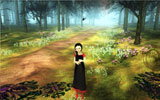
And thanks to the help of many volunteers, you can also play The Path in Danish, French, German, Hungarian, Italian, Portuguese, Romanian and Spanish, next to the English and Dutch available in the normal release. A patch that translates the game to any of these languages can be downloaded here. Credits for the translations can be found here.
Oh, and there’s also the Polish version, of course, published by Topware. We still have a few copies available in our store.
More languages will be added later. We’re working on Arabic, Czech, Japanese and Korean at the moment.
The ever eloquent Bruno de Figueiredo picked our brains when we were working on Fatale and has now published the result with a bunch of work-in-progress pictures. Enjoy!
To a large extent, FATALE is about looking. We follow Wilde’s version of the story in this. You start as John the Baptist in a situation where you’re being looked at – by Salome – against your will. Then because of the looking of another person – King Herod at Salome – you are put to death. And finally you meet Salome who claims that if you would have looked at her, you would have loved her. And, presumably, none of this would have happened.
Posted by Michaël Samyn on December 21, 2009 | 8 comments | Filed Under: Fatale, Press
Six years ago, on a freezing snowy day like today (at least that’s how I remember it), the document that founded “Tale of Tales BVBA” was officially published. To celebrate our anniversary, we’re discounting our three commercially available downloads for the week. As a lucky coincidence, this means you can still get a quick and cheap and very original Christmas gift for your loved ones! :)
From now until next Saturday, you can get The Path for 6.66 US Dollars (30% off).
Available from the regular page.
D. Yvette Wohn sent us a bunch of interesting questions to which we hopefully gave some enlightening answers. The resulting big interview is here
Unlike most games, which put you on a roller-coaster ride away from your own life, our games act as pause buttons. Take a moment and allow yourself to breathe. That’s why their slowness might come as a kind of shock when you start up the game. Like a speeding truck coming to a sudden halt.
Posted by Michaël Samyn on December 16, 2009 | 8 comments | Filed Under: Press
Giochi (Games) Magazine of Italy has written a rather extensive review of FATALE this month, in which they give the game a perfect 10/10. We don’t read Italian but we can feel the love. Thank you!
Also a short article about us and FATALE appears in this month’s issue of Wired UK Magazine:
And Wired.co.uk has published more of the complete interview with us at their site.
Edit: journalist Daniel Nye Griffiths posted even more on his blog.
Since September 2005, when the first phase of the project was launched, 50000 people have registered for The Endless Forest, our “social screensaver” where you play a deer in a multiplayer online virtual forest. And The Endless Forest community is more vibrant than ever!
As proponent of a maximum age rating for games, it was an honour to be interviewed by Randy Yasenchak for a website called Elder Geek. On top of being old and geeky, Elder Geek is also looks great. Its design brings back fond memories of times when graphic design was something that people did on websites.
Read the interview here. It’s about The Path, Fatale, the games industry, etc. Hopefully the answers are as interesting as the questions. If not, feel free to continue the discussion in the comments. :)
Posted by Michaël Samyn on December 3, 2009 | Comments Off | Filed Under: Press
I have never cared much for mobile gaming platforms. Or mobile anything, for that matter. I come from a time when moving around meant being separated from information technology. And I guess I’m comfortable with that feeling now. Perhaps I even cherish being disconnected.
As a designer for interactive media, I was also never attracted to mobile devices. Mostly because of their small screens. One of the most important things about interactive experiences for me is immersion, immersion in a virtual world. And, partly because of their size, computer monitors and televisions screens seem to dissolve when I’m playing a game. They become invisible frames of the windows through which I experience virtual worlds.
But small devices are always there. You’re holding them in your hands, you constantly feel their material, their weight, and worst of all, you have to focus your vision to a very small physical area, the area of the small screen. As a result, I think, the best experiences I’ve had on my iPod Touch have been simplepuzzlegames, games that don’t necessarily look like representations of something large but that “fit” in the small format. Oddly, this seems to apply to both size and content. Superficial and abstract games thrive on small devices.
But that doesn’t stop me from wanting more.
Now that we’re trying to make a game for the iPhone ourselves, I’m trying to play the ones that are out there. I’m naturally inclined to look for things that have a bit of “meat around their bones”, experiences that can draw me in, make me believe in their fiction, make me want to spend time in their worlds.
But I haven’t found a lot that even comes close to this on the App Store.
Maybe the device is just not suitable for this kind of thing. Or maybe I’m looking in the wrong places. So this is a call for tips: can anyone recommend any immersive experiences on the iPhone? They don’t need to be games, they don’t need to be big. Just something that makes me feel something. That I can step into.
Posted by Michaël Samyn on November 30, 2009 | 27 comments | Filed Under: Thoughts
We are pleased as punch to announce that The Endless Forest deviantART fan club lead by Jen Stuber, has once again made a Calendar filled with beautiful artwork from players who love the game. It’s pretty freakin awesome!! Michael and I don’t have enough exclamation points! :)
All cash raised goes directly to help to fund the future of The Endless Forest. I think we can count ourselves fortunate to have such a sweet and talented player community!
And speaking of the community… The Endless Forest community website has received an overhaul these past weeks. The community site is a very lively place where TEF players of all ages can meet each other outside the game.
Hard for me to believe but TEF will have been going for 5 years in 2010. Thanks to MUDAM for continuing to support us with the game server hosting. They have been great. Anyway, maybe for the TEF 5th anniversary we’ll have to have a big party. In the forest, of course! ;)
We have upgraded The Endless Forest engine and added a new feature to the game for the occasion of the exhibition Fantastic Illusions which opened in Kortrijk last week. It’s an exhibition of work by contemporary Belgian and Chinese media artists that explores the idea of immersion (there’s two games in it: The Endless Forest and Flower). The show ran in the Museum of Contemporary Art in Shanghai in September and can now be seen in the Broelmuseum in Kortrijk until February.
The Broelmuseum collection includes several paintings by 17th century Flemish painter Roelant Savery, many of them featuring animals very prominently. One painting, entitled “De Drinkplaats”, or “the watering hole”, served as the inspiration for the addition we made to The Endless Forest.
In The Endless Forest, De Drinkplaats is a peaceful place where players can bring their deer to have a drink from an eternally flowing source. When they do, however, they change into one of the other animals that inhabit the forest, often of disproportionate size (including the new raven and bunny!). The more players gather in the place, the more magic happens (courtesy of ABIOGENESIS).
In all the discussion surrounding the experimental nature of FATALE, it’s easy to forget the amount of hard and loving work was put into its creation. So we decided to pay homage to one of the most complex elements in the production -the Dance of the Seven Veils- by putting together a “Making Of” video, documenting the collaborative effort.
From the musical composition and performance of Gerry De Mol over the improvised choreography of Eléonore Valere Lachky to Laura Raines Smith‘s painstaking effort to animate 4750 frames by hand, the clip shows how music, dance, video, animation and realtime rendering and scripting come together to deliver a performance unique to the medium.
Posted by Michaël Samyn on November 9, 2009 | 17 comments | Filed Under: Fatale
If you’ve been waiting to get FATALE on Steam, now is your chance, here.
It’s great that a mainstream games store like Steam wants to support our experiments. It really shows the desire of the medium to grow. And that’s a wonderful feeling. Even if FATALE is not your particular cup of tea, more diversity is always good. Because we all want this medium to be the medium of the 21st century.
Posted by Michaël Samyn on November 4, 2009 | 29 comments | Filed Under: Fatale
We still need to go through all 306 (!) entries but some immediately stood out, like A Slow Year, Lose/Lose, TRAUMA and Wait but there seems to be a lot more where that came from. The overall polish of the games this year seems much higher. And 2D platformers (still) reign supreme. Though I also noticed a much higher amount of 3D games than in previous years. And less (pseudo) self mocking games.
There’s a 4 page interview about FATALE in the current issue of Games TM (89) that was made before the release of the game. And there’s a rateless review of FATALE in Edge online, which I enjoyed because it’s about what the writer discovered while playing and how he appreciated it.
Video games rarely offer the chance to look so deeply at a single character, or to spend so much time lingering over an environment and enjoying it for its own sake. Tale Of Tales is a small team, but they went across disciplines to find experts in every field, from the art to the music to that wonderous dance sequence. Plenty of indies wear primitive graphics as a badge of honor; Tale Of Tales pulled off Fatale with a team of less than a dozen.
Posted by Michaël Samyn on November 3, 2009 | 8 comments | Filed Under: Fatale, Press
On Thursday, at 9 am, we will be presenting our work at the View Conference in Torino. It’s a very general event about the use of computer graphics in all sorts of fields.
VIEW Conference is the premiere international event in Italy on Computer Graphics, Interactive Techniques, Digital Cinema, 3D Animation, Gaming and VFX.
VIEW 2009 will continue to focus on exploring the increasingly fluid boundary between real and digital worlds. Through lectures, meetings, tributes, exhibits, screenings and demo presentations VIEW will reveal the new digital frontier sweeping from cinema to architecture, from automotive design to advertisement, from medicine to videogames.
There’s presentations by people from Electronic Arts, Industrial Light & Magic, Pixar, Sony Pictures Imageworks, Blue Sky Studios, etc. Us, intimidated? Naah… ;)
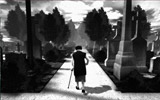
It’s All Souls’ Day today. A day to commemorate the dead. Over here, we visit cemeteries today and put flowers on the graves of family members and friends who have died. It’s a day of silence and serenity.
Those who prefer to commemorate the dead from home, can visit last year’s Independent Games Festival finalist The Graveyard. For the occasion, today, the full version of the game can be downloaded for free.
Get it here: The Graveyard for Windows – Free The Graveyard for Mac OS X – Free
Only yesterday.
—
You can still download the trial version of The Graveyard for free here.
Posted by Michaël Samyn on November 2, 2009 | 22 comments | Filed Under: Projects
Tale of Tales is a game development company founded by Auriea Harvey & Michaël Samyn. We make interactive projects that often take place in virtual spaces. Our motivation is mostly artistic. We want to discover and exploit the enormous expressive potential of realtime technology. more…
This web log was begun in February of 2007. Contact us.