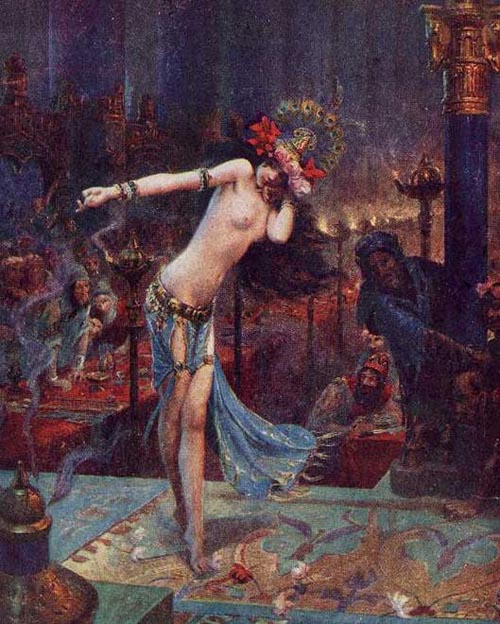
Oil painting by Gaston Bussière entitled Salomé (1914)
Bussière is one of the few painters who has depicted Salomé as a young capricious girl, the way she was described in the Bible. Other painters turn her into a mature woman and, especially in the period of Bussière, a femme fatale, devourer of men, deeply evil, and equally sensual. Bussière’s Salomé is naked and yet any sensual pleasure we may get out of looking at her is a very guilty pleasure. She is just a child, only faintly aware of her femininity.
Her dance seems to be more playful then sensuous. Bussière’s interpretation is supported by DeAnna Putman’s analysis of the character of Salomé:
Two key Greek words in the biblical accounts (Mark 6 and Matthew 14) make it very clear that Salome’s honorary dance was not salacious.
First, Salome is referred to as a korasion, meaning, a little girl not yet old enough to be married. Basically this means she had no breasts and had not menstruated yet. Second, the word used for dance here is orxeomai, which not only means dance, but the playful goofing off of young children.
Obviously this adds a layer of complexity to the story which is difficult to join with Oscar Wilde’s interpretation. Belgian youth author Ed Franck, however, was inspired by exactly this conflict: in his novella “Salome” he describes how a teenage Salomé falls in love for the first time, only to meet rejection.
Well, ANOTHER game involving teenage girls in arguably sexual situations definitely wouldn’t help your public image… 😉
Strangely, this interpretation goes right against the model of femme fatale. It’s surely much more on a level of paedophilia, wouldn’t you agree?
Also, very unlike the Salome we’re used to read about.
It’s only paedophilia if you bring the two interpretations together. If you read DeAnna Putman’s text, you’ll find that it’s perfectly plausible that the entire event was non-sexual. And that Salome’s mother, Herodias, is the true femme fatale.
But I am fascinated by the tension between the erotic and the forbidden that is always implicitly present in a growing child. This is especially pertinent in contemporary times, in which youth is celebrated and sexual attractiveness is more or less defined by youthfulness, if not childlikeness. Everyday life is completely perverted.
I can’t read with that background color =(
Reload the page and you’ll get a different color. =)
Well, if there wasn’t any sort of eroticism then what drove Herod to capture and behead John the Baptist? Or does Putman’s version exclude the beheading of John the Baptist as a consequence of Salome’s dance?
It was Herod’s wife, Herodias, who wanted the prophet killed. Apparently for a King to offer somebody a reward “up to half of his kingdom” was just a polite phrase and never meant literally. Herodias inappropriately took Herod’s words literally and manipulated her daughter, Salome, into asking for John’s head. Herodias hated John the Baptist because he disapproved of her marriage with the brother of her late husband, which he considered to be incest. But Herod was afraid of the prophet or of what would happen if he were to die (Herod is often portrayed as being superstitious).
Glad you cleared that up 😉
Which reminds me… the more you learn about the subject, the harder it must become to make decisions, namely in what has to do with the design of the game.
On the contrary! The interactive medium allows for all those different elements to be present simultaneously. The decision making work is done when playing the game. When making it, we simply stuff it with as much content as we can. 😀
Why the title for this entry?